Key takeaways
- Practice price: set at your consultation, for the plan you agree on.
- National figure: ASPS lists an average surgeon’s fee of $5,587 for male breast reduction, without anesthesia or the operating room.
- Main price driver: whether the plan uses liposuction, excision of gland tissue, or both.
- Gynecomastia during puberty often settles on its own, so surgery is not always the first step.
- Financing is available for qualified patients, including CareCredit.
This content is for general informational purposes only and should not be taken as medical or other professional advice. Readers should consult a qualified licensed professional for advice about their specific situation. Reading this page does not create a physician-patient relationship. All surgery carries risk, and individual results vary. Seek immediate emergency care for severe or urgent symptoms.
The American Society of Plastic Surgeons (ASPS) lists the parts of a gynecomastia surgery bill as the surgeon’s fee, the hospital or surgical facility, anesthesia, medical tests, post-surgery garments and prescriptions. When you compare quotes, check each against that list, and ask about prescriptions separately so nothing is left to discover after surgery.
Last Updated: November 28, 2026
Table of Contents
Is It Expensive to Get Rid of Gyno?
Getting rid of gyno with surgery is a significant expense: ASPS reports an average surgeon’s fee of $5,587 for male breast reduction, and that figure leaves out anesthesia and the operating room. The total depends mostly on whether you need liposuction, removal of gland tissue, or both.
The figure comes from the ASPS gynecomastia surgery cost page, which cites the society’s latest statistics. The newer 2025 ASPS Procedural Statistics Report counts procedures but publishes no fees; it recorded 23,318 male breast reductions in 2025, down 8% from 2024.
- Technique. Cleveland Clinic’s gynecomastia surgery page describes liposuction through small incisions, excision of breast tissue through larger incisions, or a combination of both.
- Loose skin. Removing excess skin makes the operation larger.
- Anesthesia and facility. Cleveland Clinic describes general anesthesia, which needs qualified anesthesia care and an equipped facility.
- The surgeon and location. ASPS names experience and geographic location as factors in every surgeon’s fee.
When liposuction is part of the plan, our guide to what liposuction really costs in Metro Detroit shows how that portion of a quote is put together.
The cheapest quote can cost more if it treats only fat when gland tissue also needs removing, or if it leads to a second operation. The ASPS gynecomastia results page notes that it may not always be possible to achieve optimal results with a single procedure. In an ASPS article on budgeting for surgery, plastic surgeon Michele Shermak, MD, suggests asking whether a quote includes all surgical costs and what any revision would cost.
Dr. Hardaway operates in a QUAD A accredited surgical center, where a certified registered nurse anesthetist (CRNA) manages anesthesia for every surgical case, and our article on the difference between a plastic surgeon and a cosmetic surgeon explains what to check before you book.
What to Do if I Can’t Afford Gyno Surgery?
If you can’t afford gyno surgery yet, first confirm you need it, since a healthcare provider can check for an underlying cause and review your medications. If surgery is the right step, financing can spread the cost over time. We offer financing options for qualified patients, including CareCredit.
We do not accept insurance. Be wary of saving money by traveling: the ASPS briefing paper on cosmetic surgery tourism warns that follow-up care is limited once you return home and that revision costs may total more than the first operation.
Budget for recovery as well. Cleveland Clinic says you can usually go back to work in about two weeks and should avoid heavy lifting and reaching overhead at first, and the ASPS budgeting article adds costs such as a partner’s time off, childcare and prepared meals.
What Shrinks Gynecomastia?
For teenagers, time often shrinks gynecomastia without surgery: Cleveland Clinic says the hormone imbalance behind it during puberty usually regulates in about six months to two years. A healthcare provider can also look for an underlying medical condition and review your medications and supplements, which could save you the cost of an operation you do not need.
The Cleveland Clinic overview of gynecomastia advises talking to your provider if the condition is causing you distress or comes with new symptoms. If the tissue has not gone away and it still bothers you, that is when a surgical consultation makes sense.
Is Male Breast Reduction Surgery Worth It?
Whether male breast reduction surgery is worth it depends on how much the tissue affects you and whether you accept the trade-offs. ASPS says final results can take three to six months, incision lines are permanent but fade over time, and an improved upper body will likely enhance your self-image and confidence.
Price is one part of that decision. Knowing the full figure, the recovery and a realistic picture of the result before you commit is what makes the decision yours rather than a sales conversation.
Frequently Asked Questions
Is it embarrassing to have gynecomastia?
It is far more common than many men realize. Cleveland Clinic says gynecomastia affects over 50% of males at some point in their lives, and newborn and adolescent cases are generally temporary.
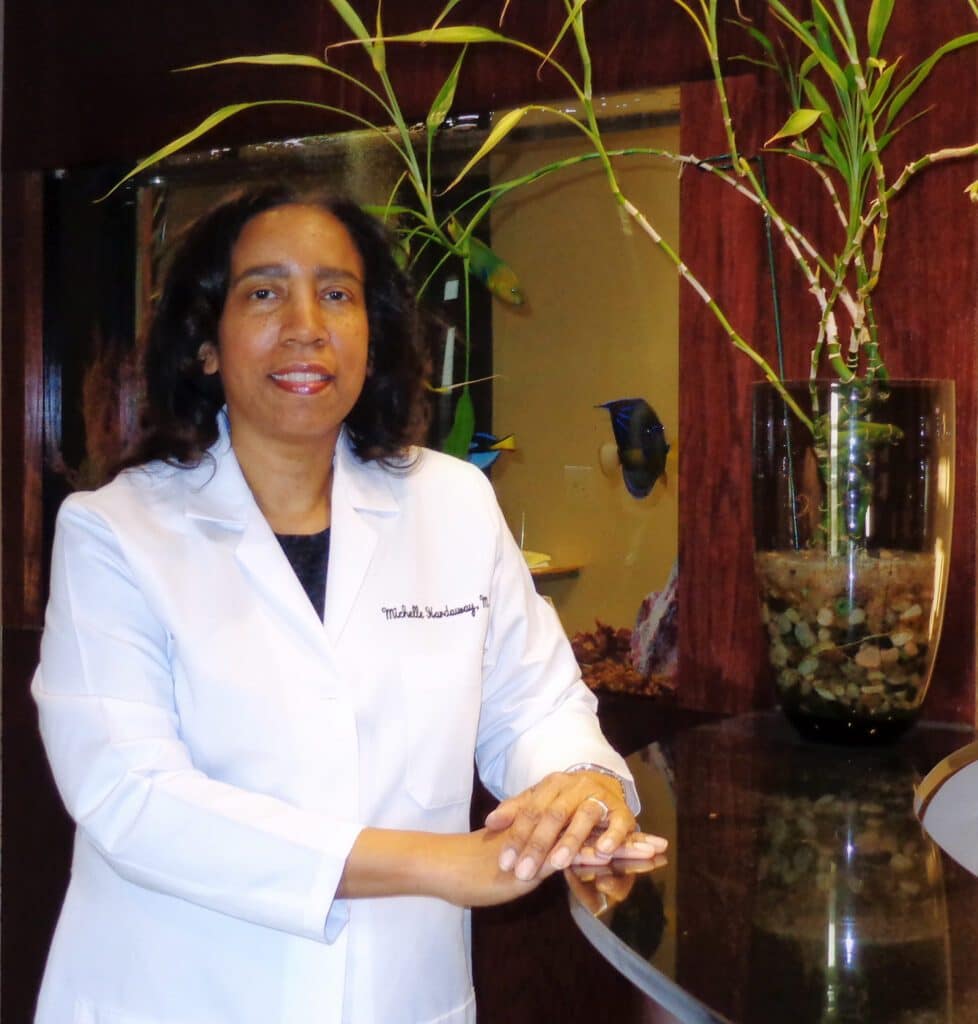
Dr. Michelle Hardaway, a board-certified plastic surgeon, sees patients from across Metro Detroit at 27920 Orchard Lake Rd in Farmington Hills. At a paid consultation in a private, confidential setting, she examines your chest, explains whether liposuction, excision or both would suit you, and prices that plan. Read about male breast reduction and other male plastic surgery at the practice, then request a consultation.
All consultations are paid and appointment-based to ensure dedicated time and a personalized plan.
Written by Michelle Hardaway, M.D., F.A.C.S., Board-Certified Plastic Surgeon
Dr. Michelle Hardaway is a board-certified plastic surgeon and Fellow of the American College of Surgeons with over 20 years of experience. A former Chief of Plastic and Reconstructive Surgery at Detroit Receiving Hospital and an Assistant Clinical Professor of Surgery at Wayne State University School of Medicine, she performs every procedure personally at her QUAD A accredited practice in Farmington Hills.