Key takeaways
- Hardest stretch: the first few days, when your lower face and neck feel sore and tight and swelling is building.
- Social recovery: most bruising and swelling settle within two to three weeks, but full healing takes months.
- Choosing a surgeon: ASPS publishes a list of consultation questions, starting with board certification and facility accreditation.
- The “new” facelift: usually the deep plane technique, which research rates highly but which is not automatically better for every face.
- Expectations: ASPS says a facelift does not change your fundamental appearance and cannot stop the aging process.
This content is for general informational purposes only and should not be taken as medical or other professional advice. Readers should consult a qualified licensed professional for advice about their specific situation. Reading this page does not create a physician-patient relationship. All surgery carries risk, and individual results vary. Seek immediate emergency care for severe or urgent symptoms.
Last Updated: November 28, 2026
Table of Contents
What Are the Worst Days After a Facelift?
The worst days after a facelift are usually the first few. ASPS says your lower face and neck will likely feel sore and tight at first, and swelling and bruising build over the first week. Most of the bruising and swelling fades within about 10 days, though full healing takes two to three months.
In its article on common facelift questions, ASPS suggests planning about two weeks off work and avoiding strenuous exercise for at least three weeks.
The practice’s recovery timeline guide describes what those early days usually look like after a facelift:
- Most patients move from prescription pain relief to over-the-counter medication within three to five days.
- Cold therapy in 20-minute sessions helps during the first 48 to 72 hours.
- You sleep with your head elevated on pillows or in a recliner.
- Dr. Hardaway removes sutures between days five and ten.
- Brief public outings with makeup are often possible by 10 to 14 days, with social recovery at two to three weeks.
Temporary numbness or tightness, and some residual swelling around the jawline and ears, are common for a while after that. ASPS also notes that small tubes may be placed to draw off excess blood or fluid, and that a bandage may be placed around your face to minimize swelling and bruising.
What to Ask a Plastic Surgeon Before a Facelift?
Ask a plastic surgeon about training and safety first, then about your own plan. ASPS suggests asking whether the surgeon is certified by the American Board of Plastic Surgery, whether the surgical facility is accredited, which technique is recommended for you, what recovery involves and how complications are handled.
ASPS publishes a fuller list of facelift consultation questions. These are among the most useful:
- Am I a good candidate for this procedure?
- What surgical technique is recommended for me?
- How long of a recovery period can I expect, and what kind of help will I need?
- What are the risks and complications associated with a facelift?
- How can I expect my face to look over time?
- Do you have before-and-after photos I can look at for this procedure?
For a step-by-step checklist that applies to any procedure, see this guide on how to choose a plastic surgeon.
The ASPS list of possible facelift risks includes bleeding, infection, facial nerve injury with weakness, numbness, prolonged swelling, hair loss at the incisions and unfavorable scarring. Hearing how your surgeon prevents and manages each one is part of an informed decision.
What Is the New Facelift Everyone Is Getting?
The facelift people usually mean is the deep plane facelift, which lifts the deeper supporting layer of the face along with the skin. It is not new, but it has become popular online. Research rates patient satisfaction highly, yet one review also found more complications, so it is not automatically right for every face.
A 2025 systematic review and meta-analysis of 21 studies and 2,896 patients compared deep plane and SMAS facelifts, the two main approaches. Patient satisfaction was 94.4% for deep plane and 87.8% for SMAS, while overall complication rates were 17.2% and 10.3%. The authors concluded that both techniques provide robust, long-term outcomes with high satisfaction.
The more useful question is which technique suits your anatomy. Dr. Hardaway’s facelift approach removes excess skin and tightens the deep tissue (SMAS), and the technique, full or mini, is matched to your face at consultation.
Can You Tell If Someone Has Had a Facelift?
You often cannot tell when a facelift is done well, because a good result looks rested rather than different. The giveaways people notice, a tight, pulled or windswept look, usually come from pulling on skin alone or from overcorrection. ASPS notes that a facelift does not change your fundamental appearance.
The deeper supporting layer of the lower face, the SMAS, continues into the platysma muscle of the neck. When that layer is repositioned, the skin can be redraped without tension, which is what keeps expressions natural. If only the face is lifted and the neck is not, the contrast can also draw attention, which is why a facelift and neck lift are often planned together, as explained in why a lower facelift and neck lift are performed together.
Scars are placed along natural creases and inside the hairline, and they fade with time. Protecting incisions from the sun with SPF 30 or higher for at least 12 months helps them settle.
What Disqualifies You From a Facelift?
Health problems that impair healing, smoking and unrealistic expectations are the main things that can rule you out of a facelift. ASPS describes good candidates as healthy people without medical conditions that impair healing, nonsmokers, and people with a positive outlook and realistic expectations. Age alone is not usually a disqualifier.
Before surgery, your history, current medications and supplements are reviewed. During your consultation, Dr. Hardaway reviews your health and surgical history to determine whether a facelift is the best option for you. Sometimes the honest answer is that a smaller procedure or a nonsurgical option fits your goals better.
What Happens to Your Face 10 Years After a Facelift?
Ten years after a facelift, your face has kept aging, but usually from a more youthful starting point. The Aesthetic Society says full facelift results generally last over ten years, while mini facelift results can last up to five. ASPS adds that a facelift cannot stop the aging process, so gradual change continues.
The Aesthetic Society’s facelift guide says today’s techniques can be consistently reliable, safe and durable. Sun protection, a stable weight and not smoking all help results hold. Some people choose smaller maintenance treatments years later, and the plan for that is easier to discuss before surgery than after.
How Many Years Does a Facelift Take Off of You?
There is no fixed number of years a facelift takes off, because results depend on your anatomy, skin and the technique used. ASPS says many patients can look as much as 10 years younger, but individual results vary, and the goal is a refreshed, confident version of yourself rather than a set number.
Expecting a specific number of years can lead to disappointment. A more helpful goal is softer jowls, a cleaner jawline and a face that matches how you feel, while still looking like you.
Frequently Asked Questions
How painful is a face lift?
Discomfort after a facelift is usually manageable with medication, and most people describe tightness, soreness and temporary numbness rather than sharp pain. ASPS lists persistent pain among the possible risks, so pain that gets worse instead of easing is worth a call to your surgeon.
How do you know when you’re ready for a facelift?
You are usually ready when jowls, a softer jawline or neck changes bother you, nonsurgical treatments no longer give the result you want, and you are healthy, a nonsmoker and realistic about the outcome. ASPS notes that minimally invasive treatments may delay, but not replace, the point at which a facelift becomes appropriate.
You can talk through every question on this list at a paid consultation at 27920 Orchard Lake Rd in Farmington Hills, convenient for patients across Metro Detroit. Board-certified plastic surgeon Dr. Hardaway operates in a QUAD A accredited surgical suite on Orchard Lake Road, and the consultation is a thorough, private conversation about your goals, your health and the trade-offs of each option, ending with a customized treatment plan. All consultations are paid and appointment-based to ensure dedicated time and a personalized plan.
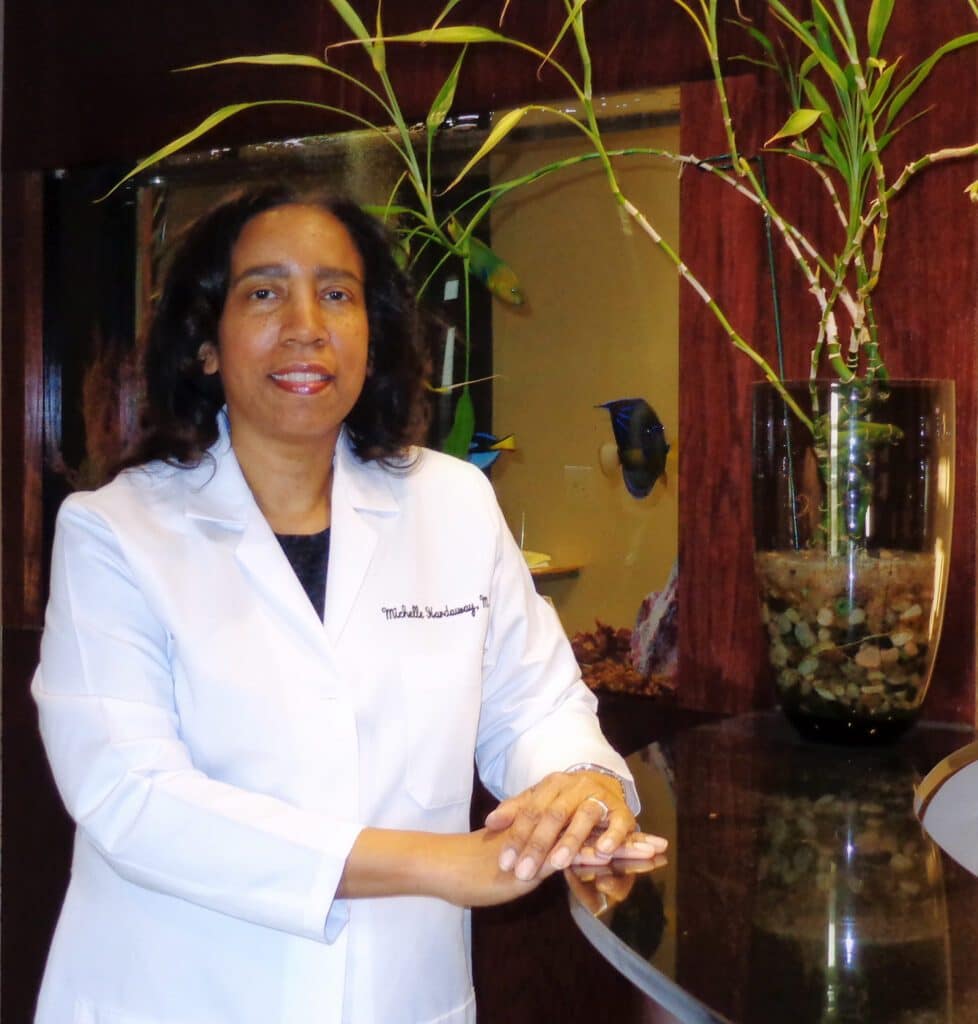
Written by Michelle Hardaway, M.D., F.A.C.S., Board-Certified Plastic Surgeon
Dr. Michelle Hardaway is a board-certified plastic surgeon and Fellow of the American College of Surgeons with over 20 years of experience. A former Chief of Plastic and Reconstructive Surgery at Detroit Receiving Hospital and an Assistant Clinical Professor of Surgery at Wayne State University School of Medicine, she performs every procedure personally at her QUAD A accredited practice in Farmington Hills.