
Written by Michelle Hardaway, M.D., F.A.C.S., Board-Certified Plastic and Reconstructive Surgeon | Former Chief of Plastic Surgery, Detroit Receiving Hospital | 40+ Years of Surgical Experience

Key Takeaways
- Diastasis recti is not one condition. It presents in four distinct locations, and the location determines exactly where your abdomen protrudes.
- A tummy tuck is not primarily a skin operation. Fascial repair is the core of the procedure; skin removal is the final step.
- If the separation is not addressed in the right location, a belly protrusion can remain regardless of how much skin is removed.
- Only a physical exam by a board-certified plastic surgeon can confirm which type of diastasis you have and whether you are a candidate for repair.
Your belly protrudes where your fascia stretched. That is the answer most patients have been waiting years to hear, and it is rarely explained with the precision it deserves.
If you have worked consistently with a physical therapist, rebuilt your core strength, and still cannot explain why your abdomen looks fundamentally different than it did before you had children, the problem is almost certainly structural. The strong connective tissue running down the center of your abdomen, called the linea alba (or fascia), has stretched in a specific location. That location is doing more to determine the shape of your belly than skin, fat, or muscle tone ever could.
This is the explanation that gets skipped in most general articles on diastasis recti. You deserve a more precise one.
What Is Diastasis Recti And Why Does It Look Different on Every Body?
The rectus abdominis muscles, the two vertical columns of muscle running down the front of your abdomen, are held together along the midline by a band of connective tissue called the linea alba. During pregnancy, the growing uterus places sustained pressure on this tissue from the inside, stretching it outward. For many women, the linea alba does not fully recover its original width and tension after delivery. That persistent stretch is diastasis recti.
According to the Cleveland Clinic, diastasis recti is common during and after pregnancy, with some estimates suggesting it is present in the majority of women during the third trimester. The key clinical point is that this does not resolve on its own in every case, and no amount of core strengthening can close a gap that has exceeded the tissue’s elastic limits.
What most patients are never told is that this stretch does not happen uniformly. The linea alba can separate above the belly button, below it, in the middle, or along its full length from top to bottom. Each pattern creates a different visual problem on the body, and each requires a different understanding of what surgery will and will not correct.
The phrase you may recognize from your own experience, “I suck in and it still sticks out,” is almost always a sign of fascial separation rather than excess fat. Fat compresses when you draw your abdomen in. Fascia does not.
The 4 Types of Diastasis Recti (And What They Mean for Your Belly)
Separation Above the Belly Button
When the fascia stretches primarily in the upper abdomen, the protrusion appears above the belly button. This often presents as a rounded dome or a raised shelf just below the ribcage. Patients with this pattern frequently describe a specific confusion: a relatively flat lower abdomen, but a belly that still appears rounded or full from certain angles.
Exercise does not correct this because upper abdominal muscles cannot pull the separated tissue back to the midline through strength training. The structural problem sits at the level of the fascia, not the muscle itself.
Surgically, this type requires fascial repair that begins high, near the xiphoid (the small bony point at the base of the sternum). A repair that only addresses the lower abdomen will leave this protrusion largely unchanged.
Separation Below the Belly Button
The lower abdominal protrusion, what many patients call the “mommy pouch,” is typically caused by separation below the belly button. The lower portion of the linea alba is also influenced by the position and weight of the uterus during full-term pregnancy, making lower diastasis particularly common.
Patients with this pattern often have reasonable upper abdominal tone but a persistent lower pouch that does not respond to weight loss or exercise. An important surgical consideration here: a mini tummy tuck, which focuses on the lower abdomen and addresses skin removal but typically limits access for full fascial repair, may not be sufficient depending on the extent of the separation. This is a critical question to raise in any consultation.
Separation in the Center (Mid-Abdominal)
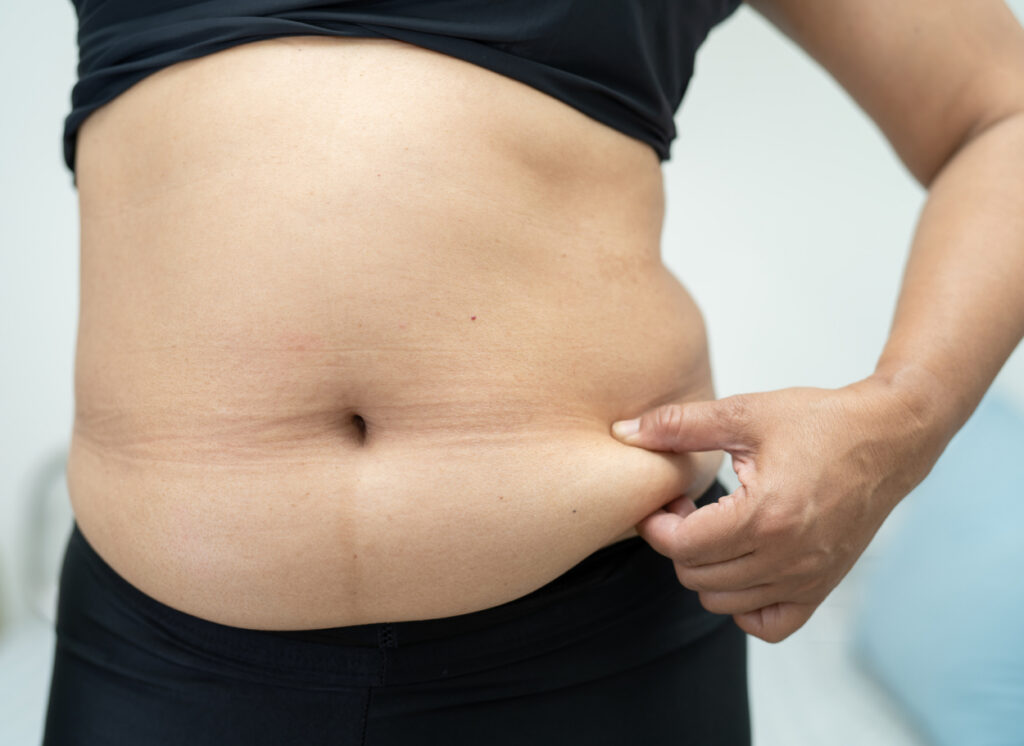
Central separation produces a more diffuse, barrel-shaped rounding that affects the mid-section broadly. Patients with this pattern often feel their entire waist looks wider than it should, rather than having a single identifiable pouch. The belly button itself may appear stretched or widened.
Central separation tends to be underestimated because it does not create one focal bulge the way upper or lower separation does. It presents as a general loss of abdominal definition and a sense that nothing quite looks “right” regardless of fitness level.
Separation the Full Length of the Abdomen
When the linea alba has stretched along its entire length, from the xiphoid down to the pubic area, the abdominal protrusion is broad and diffuse. Patients often describe their abdomen as “never looking right” regardless of weight or training. This pattern is more common after multiple pregnancies or pregnancies with larger babies.
Full-length separation requires the most comprehensive fascial repair and is the clearest indication for a full abdominoplasty rather than a limited procedure. Restoring tension along the entire midline is the surgical goal, and partial repair will produce partial results.
What a Tummy Tuck Actually Repairs From the Inside Out
The most common misconception about abdominoplasty is that it is primarily a skin operation. It is not. Skin removal is the last step of the procedure, not the first.
In my practice, the surgery begins with a low horizontal incision placed in the natural crease of the lower abdomen, positioned so it will sit below the bikini line after healing. From that incision, the skin and underlying fat are carefully elevated off the muscle wall to create access to the fascia.
The next step is the fascial repair. Working directly on the linea alba, I place a series of sutures to bring the separated edges back toward the midline and restore proper tension. I repair from the xiphoid all the way down to the pubic area. A partial repair, one that only addresses the most visibly separated zone, often leaves patients with results they cannot fully explain why they are disappointed with. The belly looks better but not quite right. In my experience, that is almost always an incomplete fascial repair.
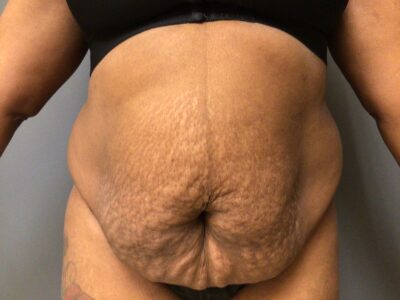
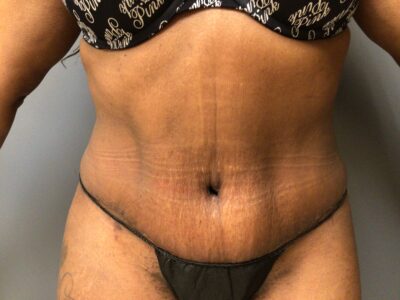
My approach involves minimal dissection of the upper abdominal skin. Rather than lifting tissue all the way up to the ribcage, I work in more of a triangular pattern that preserves tissue blood supply and reduces the extent of the dissection. The goal is to achieve the repair without unnecessary disruption to surrounding anatomy.
Once the fascial repair is complete and the waist has been contoured with liposuction, the skin is re-draped over the newly tightened abdominal wall and the excess is removed. The belly button is repositioned through a separate, precisely placed incision to preserve its natural position and appearance.
The skin removal addresses loose, overhanging tissue. The fascial repair addresses the protrusion. Both are necessary for a complete result, and they are not interchangeable.
Every patient’s anatomy is different. The approach described reflects Dr. Hardaway’s general technique; your specific surgical plan is determined during your consultation.
Why Skin Removal Alone Won’t Give You a Flat Stomach
If the fascia is not repaired, removing skin will improve the appearance of loose tissue and may eliminate an overhang. But it will not flatten the abdominal wall. The structural cause of the protrusion remains intact underneath.
This is why some patients report that their abdomen looks tighter after a procedure but still protrudes. The surgery addressed the surface layer. The architecture beneath it was not touched.
This distinction matters when you are choosing a surgeon. Not every abdominoplasty includes full fascial repair from xiphoid to pubis. Asking your surgeon specifically about the extent of the muscle repair, where it will begin and end, is one of the most important questions you can bring into that consultation room.
Curious whether your specific anatomy is a candidate for fascial repair? Schedule a tummy tuck consultation with Dr. Hardaway at our Farmington Hills surgical centerto review your anatomy and understand exactly what your procedure would involve.
How Liposuction Completes the Hourglass Contour
Fascial repair flattens the abdominal wall and narrows the waist from the front. Liposuction addresses the sides.
By contouring the flanks and lateral abdomen during the same procedure, the waist-to-hip ratio changes in a way that fascial repair and skin removal alone cannot produce. This is why patients often describe a tummy tuck result as looking not just flatter but fundamentally different in shape from all angles. The combination of internal repair and lateral contouring produces that result.
This is also why abdominoplasty is frequently combined with a mommy makeover combining tummy tuck, breast lift, and liposuction or 360-degree liposuction for body contouring, depending on each patient’s individual anatomy and goals.
“Do I Have Diastasis Recti?”How to Know Before Your Consultation
There is a straightforward self-check you can perform at home that may suggest whether a separation is present and roughly where it is located.
Lie on your back with your knees bent and feet flat on the floor. Place your fingertips horizontally across your midline just above the belly button. Slowly lift your head and shoulders as if performing a slow crunch. If you feel a gap or a soft ridge of tissue pushing upward between your fingers, you may have a separation. A gap of more than two finger-widths is generally considered clinically significant, though this varies depending on the source and clinical context.
Repeat this check above the belly button and below it. Where you feel the most pronounced gap is likely where the bulk of your separation is located and where you will tend to see the most protrusion.
Signs to note by location type:
- Upper abdomen: Rounded bulge below the ribcage that persists even when you draw your abdomen in
- Lower abdomen: Persistent lower pouch that does not change with weight loss
- Central/mid-abdomen: Broad barrel-shaped rounding, belly button may appear wider
- Full-length: Diffuse protrusion affecting the entire front of the abdomen
This at-home assessment is not a medical diagnosis. Only a board-certified plastic surgeon can confirm the presence and severity of diastasis recti and determine whether surgical repair is appropriate for your anatomy.
What To Do With This Information
You now have a more specific framework for the conversation you need to have with a surgeon. Not “do I have diastasis recti” but “where is my separation, how extensive is it, and what does a complete repair look like for my specific anatomy?” Those questions will tell you more about a surgeon’s approach than almost anything else could.
You have spent years trying to address this from the outside. Core work, physical therapy, posture corrections. None of it moved the protrusion because none of it could reach the problem. The linea alba does not respond to exercise once it has stretched beyond its elastic limit.
What changed everything for the patients I have operated on is understanding, clearly, what is actually happening beneath the skin and what surgery specifically addresses. That understanding is what makes the difference between walking into a consultation with vague hope and walking in with the right questions.
Ready to Understand What Your Anatomy Actually Needs?
Dr. Michelle Hardaway, M.D., F.A.C.S. sees patients at her QUAD A-accredited surgical center in Farmington Hills, Michigan. With more than 40 years of surgical experience, a background in complex reconstructive and burn surgery, and a history as Chief of Plastic Surgery at Detroit Receiving Hospital, she brings a depth of anatomical knowledge to abdominoplasty that goes well beyond skin removal.
Schedule your tummy tuck consultation with Dr. Hardaway
Learn more about Dr. Hardaway’s background in plastic and reconstructive surgery | View tummy tuck before and after results
Medical Disclaimer
This content is for informational purposes only and is not a substitute for professional medical advice, diagnosis, or treatment. The information presented reflects general surgical principles and Dr. Hardaway’s clinical philosophy; it does not constitute a recommendation for any specific individual. Every patient’s anatomy is different. The approach described above reflects Dr. Hardaway’s general technique; your specific surgical plan is determined during your in-person consultation.
Individual results may vary. Before-and-after images shown on this website are of actual patients and are not a guarantee of results.
Insurance coverage for diastasis recti repair varies by plan and individual clinical diagnosis. Dr. Hardaway’s team can help you navigate coverage questions during your consultation.
Dr. Michelle Hardaway, M.D., F.A.C.S. is a board-certified plastic and reconstructive surgeon operating from a QUAD A-accredited surgical suite at 27920 Orchard Lake Road, Farmington Hills, MI 48334. Consult a licensed physician before making any medical or surgical treatment decisions.
Frequently Asked Questions
What are the different types of diastasis recti?
Diastasis recti presents in four primary patterns based on where along the linea alba the fascial separation occurs: above the belly button, below the belly button, in the central mid-abdomen, or along the full length of the abdominal midline. Each pattern produces a different type of visible protrusion and requires consideration of a different extent of surgical repair during abdominoplasty.
Does a tummy tuck always include muscle repair?
Not automatically. A full abdominoplasty with fascial repair addresses the connective tissue (linea alba) from the xiphoid to the pubic area, which is the structural source of the abdominal protrusion for most post-pregnancy patients. A mini tummy tuck focuses on the lower abdomen and skin removal, and may not provide access for a complete fascial repair. Ask your surgeon specifically about the planned extent and location of the repair before proceeding.
How do I know which type of diastasis recti I have?
A simple at-home self-check can suggest whether a separation may be present and roughly where it is located. However, the location, extent, and clinical significance of any separation must be confirmed through a physical examination by a board-certified plastic surgeon. Only a hands-on surgical evaluation can determine whether you are a candidate for repair and what type of repair your specific anatomy requires.
 Med Spa or Plastic Surgeon for Botox and Fillers in Farmington Hills? A Safety Guide From a Board-Certified Surgeon
