
This content is for general informational purposes only and should not be taken as medical or other professional advice. Readers should consult a qualified licensed professional for advice about their specific situation. Reading this page does not create a physician-patient relationship. All surgery carries risk, and individual results vary. Seek immediate emergency care for severe or urgent symptoms.
You’ve noticed new veins on your legs and want to know what they are. The quickest way to sort out spider veins vs varicose veins is to look at size and at whether the vein bulges. Spider veins are small, usually red, and lie flat, while varicose veins are larger and twisted, and the larger ones may make the skin bulge out.
Contents
- Key takeaways
- What Are Spider Veins?
- What Are Varicose Veins?
- What Causes Spider Veins and Varicose Veins?
- Varicose Veins vs Spider Veins at a Glance
- Can Spider Veins Turn Into Varicose Veins?
- Do Spider Veins Go Away on Their Own?
- When to Worry About Spider Veins
- How Spider Veins Are Treated
- Varicose Veins: See a Vein Specialist
- Ask About Spider Vein Treatment in Farmington Hills
- Frequently asked questions
Key takeaways
- Vascular surgery guidelines describe spider veins as under 1 millimeter and varicose veins as 3 millimeters or more, with reticular veins in between.
- See a doctor as soon as possible if a leg suddenly swells or hurts. Trouble breathing or chest pain needs emergency care immediately.
- Spider veins can be treated with sclerotherapy or laser therapy. For varicose veins, see a vein specialist such as a vascular surgeon.
What Are Spider Veins?
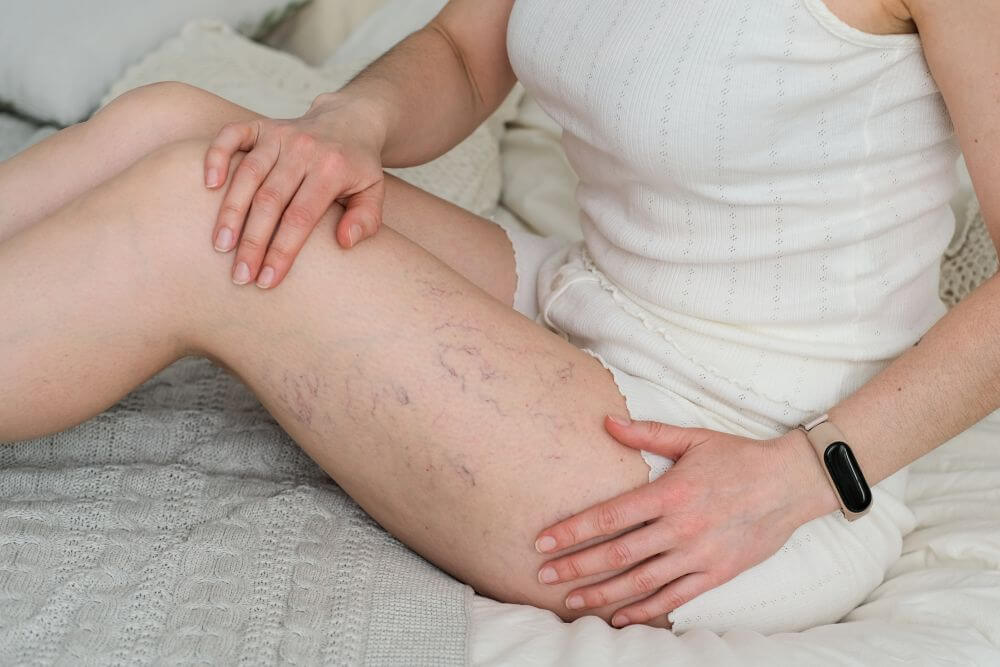
Spider veins, also called thread veins, are small veins you can see under the skin. According to the Office on Women’s Health, they’re usually red, may look like tree branches or spider webs, and are usually found on the legs or the face. They don’t make the skin bulge out the way varicose veins do, and they may affect more than half of women.
Joint 2023 vascular surgery guidelines use the medical name, telangiectasias, and describe them as spider veins under 1 millimeter in size.
What Are Varicose Veins?
MedlinePlus defines varicose veins as swollen, twisted veins that you can see just under the skin. The Office on Women’s Health adds that they can be blue, red, or skin-colored, and that the larger veins may appear ropelike and make the skin bulge out.
In the vascular surgery guidelines, a varicose vein measures 3 millimeters or more across.
What Causes Spider Veins and Varicose Veins?
When the one-way valves in your veins are weak or damaged, blood can back up and pool in your veins, which makes them swell, MedlinePlus explains. According to the Office on Women’s Health, your risk of varicose veins and spider veins may be higher if you:
- Have a family or personal history of either one
- Sit or stand for long periods, especially more than 4 hours at a time
- Have overweight or obesity
- Are pregnant, and more of both may appear with each additional pregnancy
- Are older, since vein valves may weaken with age
- Use hormonal birth control or menopausal hormone therapy
- Have had blood clots in the legs or scarring of the veins
Varicose Veins vs Spider Veins at a Glance
| Spider veins | Varicose veins | |
|---|---|---|
| Size | Under 1 millimeter | 3 millimeters or more |
| Look | Usually red; may look like tree branches or spider webs | Blue, red, or skin-colored; the larger veins may appear ropelike |
| Surface | Can usually be seen under the skin without a bulge | The larger veins may make the skin bulge out |
| Where | Usually the legs or the face | Under the skin on the legs |
| Symptoms | Some people have none; others have tired, heavy, or achy legs | May include aching, heaviness, throbbing, cramping, swelling, and itching |
| Health problems | Don’t usually cause health problems | Can sometimes lead to sores, bleeding, or blood clots |
| Typical causes | Valve problems in the veins | Weak or damaged vein valves |
If comparing varicose vs spider veins on your own legs is hard to call, a provider can examine your legs and may check blood flow in the veins, according to MedlinePlus.
Can Spider Veins Turn Into Varicose Veins?
Federal health guidance and the vascular surgery guidelines don’t say whether spider veins turn into varicose veins, or how often.
The vascular surgery guidelines place spider veins in Class C1 of the system doctors use to classify vein disorders. They also state that:
- Routine ultrasound isn’t recommended for spider veins that cause no symptoms
- Ultrasound may be done if spider veins bleed or cause severe pain or burning, to rule out a related vein problem
- There’s no scientific evidence that treating spider veins without symptoms prevents vein complications
If you’re trying to figure out first stage varicose veins vs spider veins, the guidelines sort veins by size: under 1 millimeter for a spider vein, 1 to just under 3 millimeters for a reticular vein, and 3 millimeters or more for a varicose vein. An exam is how you’ll find out which kind you have.
Do Spider Veins Go Away on Their Own?
Federal health guidance and the vascular surgery guidelines don’t say whether untreated spider veins fade on their own.
The Office on Women’s Health does address pregnancy, but for varicose veins: for some women they shrink or disappear after childbirth, and for others they stay.
You may not be able to prevent them, especially if they run in your family. Steps that may help include:
- Exercising and losing extra weight, which may prevent new varicose veins or spider veins from forming
- Raising your legs when you rest and not crossing them when you sit, which MedlinePlus says can help keep varicose veins from getting worse
When to Worry About Spider Veins
According to the Office on Women’s Health, spider veins are often painless and don’t usually cause health problems. If you do get symptoms, your legs may feel extremely tired, heavy, or achy, often worse after sitting or standing for a long time and better after resting with your legs up.
Talk to your doctor if the veins cause you pain, or if:
- A vein has become swollen, red, or very tender or warm to the touch, which can be a sign of a blood clot
- You have sores or a rash on your leg or near your ankle
- The skin on your ankle or calf changes color
- A vein begins to bleed
- Your symptoms keep you from doing daily activities
Signs That Need Care Right Away
Deep vein thrombosis, or DVT, is a blood clot that forms in a vein deep in the body. MedlinePlus lists a sudden increase in pain or swelling, fever, or redness of the leg as reasons to contact your provider. The CDC says to see your doctor as soon as possible for DVT signs such as swelling, pain or tenderness, warmth, or redness.
A clot can break off and travel to the lungs. Seek emergency medical help immediately if you have difficulty breathing, a faster than normal or irregular heartbeat, chest pain that worsens with a deep breath or coughing, coughing up blood, or lightheadedness or fainting, which the CDC lists as warning signs of a clot in the lungs.
How Spider Veins Are Treated
Spider veins can be treated with sclerotherapy or laser therapy. Whether treatment makes sense for you, and which option fits, is something a provider can assess at a consultation.
- Sclerotherapy: a chemical is injected into the vein, which makes the vein walls swell, stick together, and seal shut. The vein should fade in a few weeks, and you may need more than one treatment, according to the Office on Women’s Health. The vascular surgery guidelines recommend sclerotherapy for symptomatic spider veins.
- Laser therapy: laser treatment is used on veins smaller than 3 millimeters in diameter, per the Office on Women’s Health. For symptomatic spider veins, the guidelines suggest it in particular cases, such as an allergy to the sclerotherapy chemical, a fear of needles, or when sclerotherapy hasn’t worked.
MedlinePlus publishes a risk list for varicose vein treatment in general, a category it says includes sclerotherapy, which works best for spider veins, and laser treatment. That list includes blood clots, nerve damage, vein irritation, bruising or scarring, failure to close the vein, and the vein returning over time, and MedlinePlus suggests asking your provider about specific problems you might have.
How much difference you’ll see varies from person to person, and new spider veins can still form after treatment. Your consultation ends with a personalized treatment plan or with a referral elsewhere if the veins aren’t spider veins.
If you’re comparing providers, this guide to choosing a plastic surgeon in Farmington Hills covers the credentials worth checking.
Varicose Veins: See a Vein Specialist
Varicose veins are treated by vein specialists, such as vascular surgeons. The Society for Vascular Surgery says it’s important to see a vascular surgeon even when surgery isn’t needed and suggests an appointment if you have:
- Large varicose veins in the thighs, legs, or ankles
- Swelling in the legs or ankles
- Tight or darkening skin around the lower legs and ankles
- Leg cramps or spasms
- Painful, open sores on the ankles or legs
Ask About Spider Vein Treatment in Farmington Hills
If spider veins on your legs or face bother you, Aesthetic Plastic Surgery & Laser Center in Farmington Hills treats them with sclerotherapy and laser therapy, described on the spider vein treatment page for Farmington Hills patients. For varicose veins, the practice will point you to a vein specialist.
Dr. Michelle Hardaway is a board-certified plastic surgeon with over 20 years of experience and a Fellow of the American College of Surgeons. She previously served as Chief of Plastic and Reconstructive Surgery and as Director of the Burn Center at DMC Detroit Receiving Hospital.
You can request a consultation in Farmington Hills or call (248) 221-1957. If you’d rather ask a question first, send a message to the Oakland County office. The practice is at 27920 Orchard Lake Rd, Farmington Hills.
All consultations are paid and appointment-based to ensure dedicated time and a personalized plan.
Frequently asked questions
What’s the difference between spider veins and varicose veins?
Spider veins and varicose veins differ in size and in how they look. Vascular surgery guidelines describe spider veins as under 1 millimeter, reticular veins as 1 to just under 3 millimeters, and varicose veins as 3 millimeters or more.
Do spider veins go away?
Federal health guidance and the vascular surgery guidelines don’t say whether untreated spider veins fade on their own.
When should I worry about spider veins?
Talk to your doctor if a vein becomes swollen, red, very tender, or warm, or if you notice sores, a rash, or skin color changes near your ankle or calf. See a doctor as soon as possible for sudden leg pain or swelling, and seek emergency care immediately for trouble breathing or chest pain.
What’s worse, varicose veins or spider veins?
The Office on Women’s Health says varicose veins and spider veins are often painless and don’t usually cause health problems. Sometimes, though, varicose veins can lead to more serious health problems, including sores, bleeding, or blood clots. Talk to your doctor if any vein becomes swollen, red, very tender, or warm, which can be a sign of a blood clot.
Can you get rid of spider veins and varicose veins?
Spider veins can be treated with sclerotherapy or laser therapy. The Office on Women’s Health says you may need more than one treatment, that spider veins may come back, and that new ones can develop over time. For varicose veins, see a vein specialist such as a vascular surgeon.
Are spider veins the first stage of varicose veins?
Federal health guidance and the vascular surgery guidelines don’t say whether spider veins lead to varicose veins. The guidelines sort veins by size, and an exam is how you’ll find out which kind you have.
 Rhinoplasty Recovery Timeline: What to Expect From Week One to Year One
